
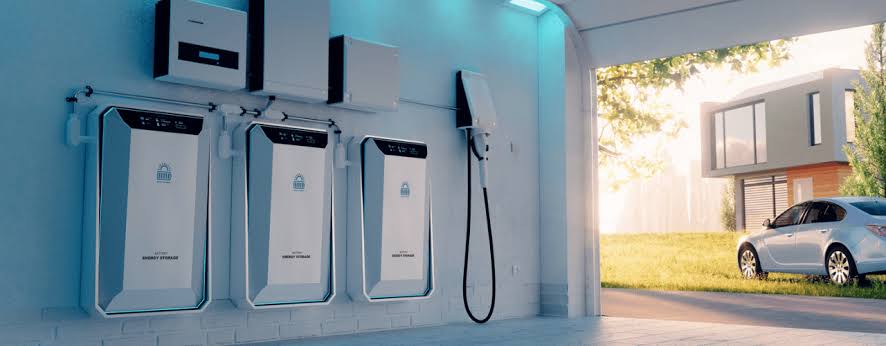
Solar panels generate power when the sun is out, but most of us use the most electricity when it isn’t: in the evening, at night and early in the morning. A solar battery closes that gap. It stores the extra energy your panels produce during the day so you can use it later, or when the grid goes down.
But batteries are a big investment, so the question is fair: is one worth it for you? This guide explains how solar batteries work, the main types, how to size one, and how to decide.
How a Solar Battery Works
During the day, your panels often produce more power than your home needs. Without a battery, that surplus is either sent to the grid (if your setup allows it) or wasted. With a battery, the surplus charges the battery instead. When the sun sets, your home draws from the battery rather than the grid or a generator.
A basic setup has four parts:
- Solar panels that generate DC electricity
- A battery bank that stores energy
- An inverter (often a hybrid inverter) that converts DC to AC for your appliances and manages charging
- A charge controller or battery management system (BMS) that protects the battery from overcharging, over-discharging and overheating
Main Types of Solar Batteries
Lithium Iron Phosphate (LiFePO4 / LFP)
The most popular choice today. LFP batteries are safe, long-lasting and low-maintenance.
- Typical lifespan: 3,000 to 6,000+ charge cycles
- Usable capacity: commonly 80–95% of the rated capacity
- Maintenance: virtually none
- Higher upfront cost, but usually the lowest cost over their lifetime
Lead-Acid (Flooded and AGM/Gel)
The traditional option, with a lower purchase price.
- Typical lifespan: 500 to 1,500 cycles, depending on use
- Usable capacity: about 50% is recommended to avoid shortening life
- Maintenance: flooded types need regular topping up with water and good ventilation
- Heavier and bulkier for the same usable energy
Other Lithium Chemistries
NMC and similar lithium-ion types are compact and powerful, but generally have a shorter cycle life and a higher thermal-runaway risk than LFP, which is why LFP dominates home storage.
The short version: lead-acid is cheaper to buy, but lithium (especially LFP) often wins on cost per kWh delivered over its life.
Key Terms You’ll See on a Datasheet
- Capacity (kWh): how much energy the battery stores.
- Power rating (kW): how much load it can supply at once. A battery with big capacity but a small power rating may not run heavy appliances together.
- Depth of discharge (DoD): how much of the capacity you can safely use.
- Cycle life: how many full charge/discharge cycles before capacity drops significantly (often to 70–80%).
- Round-trip efficiency: the share of energy you get back out versus what you put in. Good lithium systems reach about 90% or more.
How to Size a Solar Battery
Getting the size right is the most important step. Too small and you run out at night; too big and you pay for capacity you never use.
- List what you want to power. Decide whether you’re backing up the whole house or only essentials such as lights, fridge, TV, Wi-Fi, phone charging and fans.
- Calculate daily energy use. Multiply each appliance’s wattage by hours used per day, then add them up and convert to kWh. Your electricity bill also shows monthly usage you can divide by 30.
- Decide your evening and night needs. The battery mainly covers the hours without sun, so estimate how much of your daily energy falls in that window.
- Account for usable capacity. If a battery has 10 kWh rated capacity and 90% usable, you effectively have 9 kWh.
- Add a buffer. Allow extra for cloudy days, efficiency losses and future appliances.
Example: If your essentials use 6 kWh between sunset and sunrise, and you choose a battery with 90% usable capacity, you need roughly 6.7 kWh of rated capacity. In practice you’d round up to the next available size, often 7–10 kWh.
Your solar array also needs to be big enough to run the house during the day and recharge the battery, so the panels, battery and inverter should be planned together.
The Benefits
- Backup power during outages. The biggest draw in areas with unreliable grids.
- Less fuel and generator use. Quieter, cleaner and often cheaper than running a generator.
- Higher use of your own solar energy. You consume more of what you generate instead of wasting it.
- Possible bill savings. Especially where there are time-of-use tariffs or low payments for exported power.
- Energy independence. You rely less on the grid and on fuel supply.
The Drawbacks
- Upfront cost. Batteries can be the most expensive part of a system.
- Limited lifespan. Even good batteries eventually need replacing.
- Added complexity. More components mean more to install and maintain correctly.
- Capacity limits. A battery can’t run everything forever; heavy loads like air conditioners, water heaters and electric cookers drain it fast.
So, Is It Worth It?
A battery makes the most sense if:
- Power cuts are frequent or long where you live
- You currently spend a lot on diesel or petrol for a generator
- You use most of your electricity in the evening or at night
- Your utility pays little for exported solar power
It may be less compelling if your grid is stable, you use most of your power during the day, or your budget is tight. In that case, a solar-only system can still deliver strong savings, and you can often add a battery later if you choose a hybrid-ready inverter.
Tips to Get the Most from Your Battery
- Buy from reputable brands with a clear warranty (look at the guaranteed cycles and years, not just the price).
- Install it in a cool, dry, ventilated place away from direct sun.
- Match the inverter and battery so they communicate properly.
- Don’t overload it. Move heavy appliances to daytime use when the panels power them directly.
- Have it installed by qualified professionals and keep up with periodic checks.
So…
A solar battery turns solar from a daytime-only source into round-the-clock power. Whether it’s worth it depends on your outage experience, your usage pattern and your budget, but for many households and small businesses, the peace of mind alone is valuable.
Not sure what size or type is right for you? Talk to the team at Adexa Power World for guidance on designing a system around your actual energy needs.